
History
Queen of the most holy Rosary parish in Roosevelt, New York.
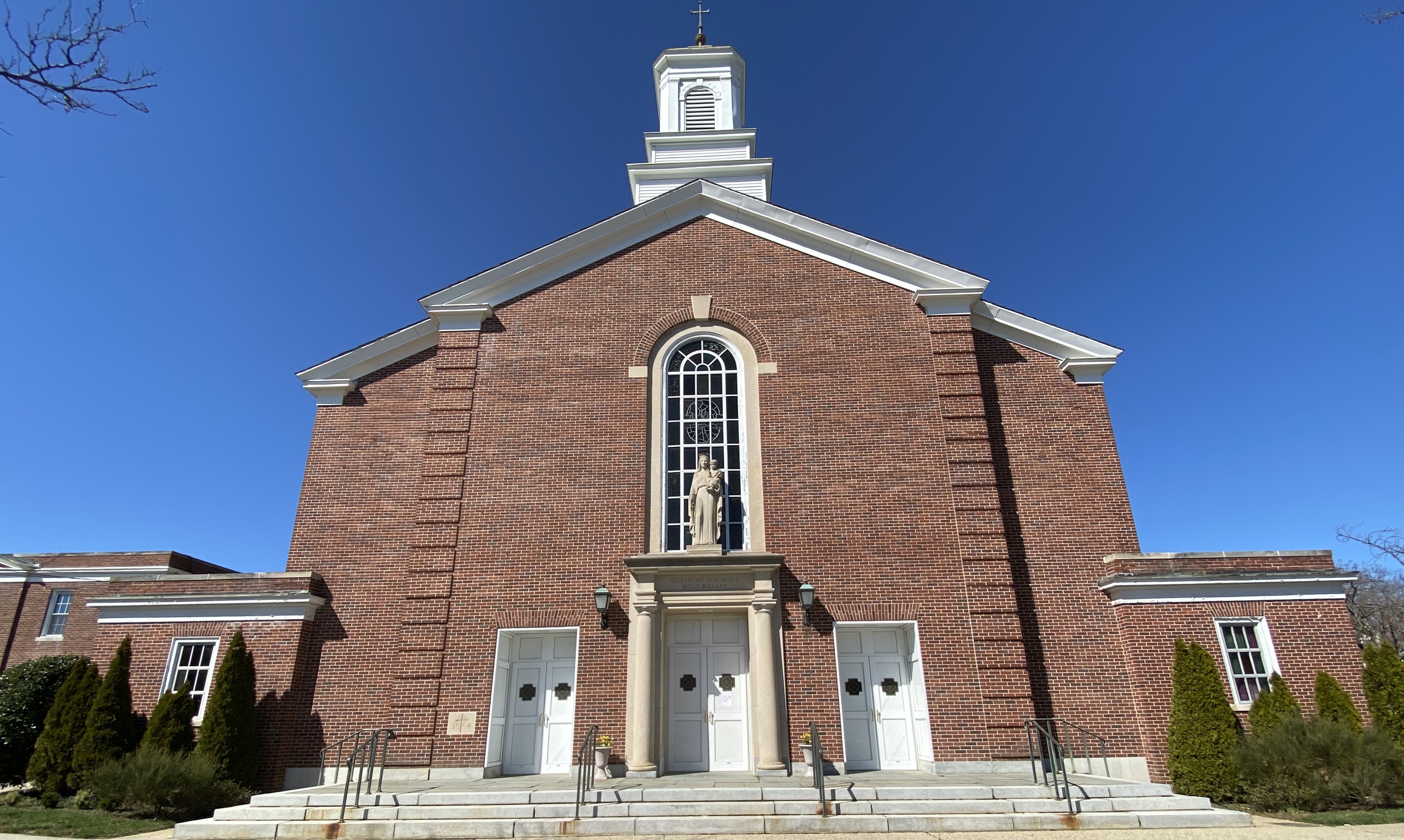 Its beginings.
The history of Roosevelt begins in the days of the first Dutch settlements in what was then new Amsterdam in the 1600s. The great plains of Hempstead to the north, the Meadows and marshes of the south shore found the area known as the great Southwoods in between. As settlements grew in the Hempstead and Freeport area in Nassau, and Babylon in the Suffolk area, carriage trails were broken through the Woodlands to connect each of these villages; - Hempstead to Babylon by the Babylon Turnpike, Hempstead to Freeport by Nassau Road. The intersection became a regular stopping point for the carriage to water the horses, to slake the thirst of passengers, to meet and join in greeting with fellow travelers. The pubs catered to elegant tastes with fine liquors from all parts of the world and attracted favorable attention. With its several excellent eating and drinking establishments clustered about the intersection, the stage coach stop-off became known as Rum Point. This name continued until 1830. As the land began to be deeded to individual owners and farmers, the name of the area became Greenwich Point. This name lasted through the growth of the village until the turn-of-the-century. And then the residents sought a local post office in 1901 under the name Greenwich Point. Because that name was already being preempted by another place in New York, the local residents, to honor Teddy Roosevelt who had come to dedicate the newly erected public school, chose the name Roosevelt for their community.
It was about this time that the Pashette family came to this area. They established themselves with a farm on what is now Park Avenue in the heart of Roosevelt. More people began to move into the area - South Hempstead, North Merrick, North Freeport, North Baldwin. All these areas were contiguous to Roosevelt without the present parkways and thoroughfares that now sharply mark off the boundaries. Meadowbrook Creek on the east and Melbourne creek on the west flowed through the area and set it’s extent. The Marina family came to North Merrick in 1901 and later moved to Roosevelt proper. Jeremiah O’Leary and his family lived on Babylon Turnpike. Mr. and Mrs. John Fenn moved into Roosevelt in 1910.
In 1911 John Fenn and Jeremiah O’Leary spoke with Fr. Logue, The pastor of Holy Redeemer Parish In Freeport about starting a mission church in Roosevelt. Fr. Logue approved and directed his assistant Fr. John L. O’Toole to work with them. He pointed out that it would be necessary to gather 25 families. It took two years to assemble those 25 families from Roosevelt and it’s environs. Finally, on Sunday, 26 April 1913, 20 of the 25 families gathered for the holy sacrifice of the mass in the Royale moving picture theater on Nassau Road and Henry Street. From then, weekly masses by Fr. O’Toole continued in the theater as a mission from Freeport, for seven long years. Through the years of the first world war in the armistice, the beginning of women’s suffrage through the end of the prohibition, Roosevelt grew. Some more Catholic families moved into the area: the Bears, the Kehls, the Bauers, the McFarland, the Seerys, the Schneiders, the Solmos, the Dolans and others.
In 1914 a talk with Fr. Quealy, the pastor of St Agnes parish in Rockville Centre, revealed that 150 families would have to be assembled in order to establish an independent parish. It took until 1919 to gather this number of families. Meanwhile Fr Logue, the pastor in Freeport, donated their old, small wooden church which was moved on skids, one half at a time, up Main Street, Seaman Avenue and Babylon Turnpike, to the property in Harts Avenue where it stood for 45 years. Before that feat of moving was completed, Bishop Thomas Malloy, the then bishop of the diocese of Brooklyn, arranged for Fr John B. Gorman to establish a full-fledged parish here in Roosevelt. Father Gorman offered the first mass of the newly established Queen of the Most Holy Rosary parish in the same Royale theater on Sunday, October 5, 1919 at 8:00 and 10:30am. Fr Gorman quickly had the goodwill and cooperation of the people of Roosevelt, both Catholic and non-Catholic. After 15 months he was transferred to Brooklyn as the new director of cemeteries until his death in the 1950s.
During his 15 months in Roosevelt Fr Gorman had 41 baptisms and 10 weddings. The first Mass in the Church on Harts was on July 11, 1920. 32 children received their First Holy Communion there on July 25th, 1920. The first person to be baptized in this parish was Joseph Francis Friar; the first marriage was between Albert Crevoisserat and Isabel Schreiner on November 19, 1919.
Fr Gorman had given the church a very strong start and a solid basis of growth. It was a sad day of farewell that Sunday, January 16, 1921, when he said his last Mass as the pastor of the the Queen before moving to Brooklyn. Fr Matthew Quealy was the pastor from January 1921 until 1933. Roosevelt was growing at pace with its neighbors Freeport and Hempstead. During those years The Catholic Club was started as a meeting place for the men of the parish on every Saturday night. Good social enjoyment in a congenial Catholic atmosphere was it’s purpose. Many non-Catholics belonged to the club. With no assistants initially, Fr Quealy relied on the help of the first trustees John Fenn and John Schneider. In the later 20’s various priests came in on Sundays to assist Fr Quealy. The Gallagher and Seery families, the Engkes and the Carrottas became very active in the parish. Parishioners we’re well acquainted with one another and helped enlarge the rectory and wire the church for electricity. The first young man ordained to the priesthood from QMHR was Francis L McGann. He had been a faithful altar server and joined the English Benedictines. He became a US Navy chaplain and was slated for the office of chief of chaplains. Fr John O’Sullivan was another young man who attended the public school here, went to Cathedral College in Brooklyn, the seminary in Huntington, and was ordained a priest for the diocese of Brooklyn. From then, the son of the Killians became a Trappist monk; the Mooney’s son, a Trinitarian missionary. Those were the active days of the Ku Klux Klan in many places on Long Island. Three times they burned their crosses on the church lawn, but they never got anywhere and the lively good spirit of the Queen continued and the parish progressed - children received the sacraments, societies grew and strengthened, the poor were taken care of, and the work of Christ and the church continued.
In June 1945 Fr John Bukey became the pastor, and with the help of a great economic boost in Roosevelt he led in the purchase of these properties for the construction of the much needed school building and later, of the church, convent and rectory buildings. This was an immense undertaking, and the parishioners, who knew the importance of these projects to their faith life, backed Fr Bukey with their full support. The beauty of the church, the convenience of the convent, and the practicality of the rectory spoke of the wisdom and foresight of the people and their priests. In a short period Fr Bukey secured, with very limited means, what the parish would need for a complete parish life and operation. Under the guidance of the Holy Spirit, a mission parish began with 25 families. The Depression and world wars notwithstanding, an independent parish emerged where, by God’s grace, many still come to find a place to believe, to belong and to be Family.